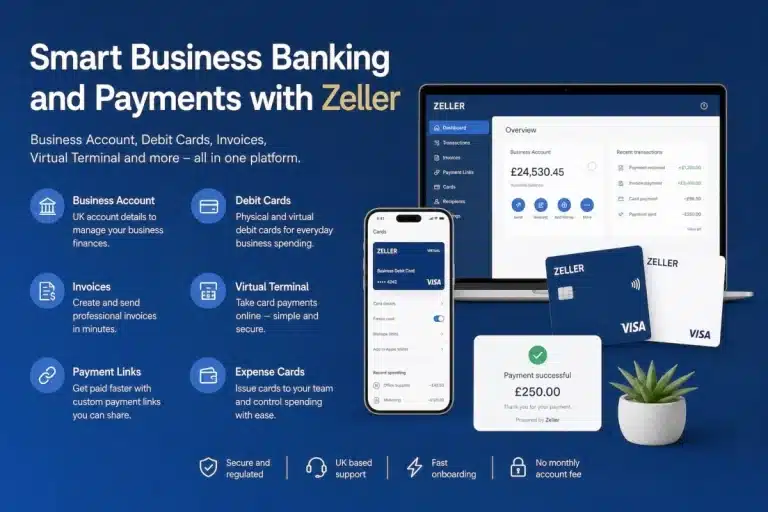

Business Debit Cards vs Credit Cards
Debit and credit cards may look almost identical, but they use company funds in very different ways.
A debit card normally uses money already available in the business account. A credit card allows the company to borrow up to an approved credit limit and repay the amount later.
Neither option is automatically better. The right choice depends on the company’s cash flow, spending habits, travel requirements, financial controls and ability to repay credit on time.
What Is a Business Debit Card?
A business debit card is linked directly to the company’s account. Card payments are normally deducted from the available balance shortly after the transaction is completed.
The business generally cannot spend more than the funds available, unless the account includes an agreed overdraft or another credit facility.
What Is a Business Credit Card?
A business credit card provides access to a credit limit approved by the card issuer. Purchases are added to the card balance and repaid according to the billing terms.
Interest or additional charges may apply when the balance is not paid in full by the required date. Approval may also depend on the company, its financial history and the people connected with it.
Key Advantages of Business Debit Cards
Clear Spending Control
Spending is generally limited to the available account balance, which can reduce the risk of building up interest-bearing card debt.
Immediate Account Overview
Transactions usually appear in the business account activity quickly, helping the company monitor expenses and available funds.
Simpler Administration
A dedicated business card helps separate company purchases from personal spending and can simplify bookkeeping and expense reporting.
No Separate Credit Balance
Routine purchases are made using the company’s own available funds rather than accumulating a separate monthly credit balance.
Key Advantages of Business Credit Cards
Short-Term Payment Flexibility
Credit can help a company manage the timing difference between making a purchase and receiving customer payments, provided repayments remain manageable.
Travel and Reservation Use
Hotels, vehicle-rental companies and other merchants may prefer or require a credit card when placing a temporary deposit or pre-authorisation.
Possible Card Benefits
Depending on the issuer and card plan, benefits may include rewards, expense tools, insurance or other services. Conditions should always be checked carefully.
Separate Credit Limit
An approved credit limit may allow essential purchases to continue without immediately reducing the company’s operating account balance.
Business Debit Card and Credit Card Compared
| Feature | Business Debit Card | Business Credit Card |
|---|---|---|
| Source of funds | Funds available in the company account | Credit provided up to an approved limit |
| Repayment | No separate card bill in normal use | Balance must be repaid under the card agreement |
| Interest risk | Normally no card interest unless another credit facility applies | Interest may apply to unpaid or carried balances |
| Application review | Account and compliance checks normally apply | Compliance checks and credit assessment may apply |
| Spending control | Generally limited to available company funds | Limited by the approved credit limit and internal controls |
| Hotels and vehicle rental | May not be accepted for every deposit or reservation | Often more widely accepted for pre-authorisations |
| Rewards and benefits | May be limited or unavailable | May include rewards or added services, depending on the plan |
| Debt exposure | Lower when only existing funds can be spent | Higher if balances are not repaid responsibly |
When Might a Debit Card Be More Suitable?
Consider a Debit Card When
- The company wants to spend only available funds
- Clear day-to-day expense control is a priority
- The card is mainly used for software and routine purchases
- The business wants to avoid interest-bearing card balances
- Employees need controlled access to company funds
Consider a Credit Card When
- The company needs short-term payment flexibility
- Travel, hotels or vehicle rental are regular expenses
- The business can reliably repay the balance on time
- The card’s additional services provide genuine value
- A separate credit limit supports planned company purchases
Can a Company Use Both?
Yes. Many businesses use debit and credit cards for different purposes. A debit card may be used for everyday operating expenses, while a credit card may be reserved for travel, larger purchases or temporary deposits.
Using more than one card can improve flexibility, but it also requires clear internal rules. The company should decide who may use each card, which expenses are permitted and how receipts and transactions are reviewed.
Important Costs and Risks to Compare
- Monthly or annual card fees
- Interest rates and late-payment charges
- Foreign-exchange margins
- International transaction fees
- Cash-withdrawal charges
- Employee and additional-card fees
- Daily purchase and withdrawal limits
- Automatic subscription renewals
- Card replacement and delivery costs
Purchase protection, insurance and dispute rights vary. Do not assume that every credit card provides stronger protection or that every debit card provides less protection. The applicable rights depend on the card issuer, card network, country, transaction type and terms of the specific card.
Questions to Ask Before Choosing a Business Card
How will the card be used?
Consider whether the card is intended for everyday purchases, subscriptions, employee expenses, travel or larger transactions.
Can the company repay credit reliably?
A credit card should not be used as a long-term solution to an underlying cash-flow problem.
Which currencies will be used?
Review currency conversion, international payment fees and whether the card is suitable for the company’s main markets.
What controls are available?
Look for spending limits, employee permissions, payment notifications, virtual cards and the ability to freeze cards.
What does the complete service cost?
Compare the full pricing structure rather than focusing only on a free card or advertised reward.
Important: BR Economy provides general information and comparison guidance. We are not a bank, card issuer or financial adviser. Card availability, eligibility, fees, credit limits and application decisions are determined independently by each provider.
Explore Related Business Card Resources
Learn more about business accounts, virtual cards and payment features before selecting a provider.

Frequently Asked Questions About Business Debit and Credit Cards
Answers to common questions about spending control, credit checks, interest, employee cards and international use.
What is the main difference between a business debit card and a credit card?
A debit card normally uses money already available in the company’s account. A credit card allows the company to spend up to an approved credit limit and repay the amount later under the card agreement.
Is a business debit card safer than a credit card?
Neither card type is automatically safer in every situation. Security depends on the provider’s controls, authentication methods, card network, company procedures and how quickly suspicious activity is reported. Debit cards can reduce credit exposure, while credit cards may offer different dispute or protection features.
Does a business credit card always charge interest?
Not necessarily. Interest may be avoided when the full balance is paid by the required due date, depending on the card terms. Interest, late-payment fees or other charges may apply when balances are carried forward or payments are missed.
Is a credit check required for a business credit card?
Often, yes. The issuer may review the company’s financial position, trading history, owners or directors and the requested credit limit. Requirements vary between providers and countries.
Can employees receive separate business cards?
Many providers offer additional physical or virtual cards for employees. The company may be able to set spending limits, restrict certain transactions and monitor payments through a central account dashboard.
Which card is better for subscriptions and online purchases?
A debit card or virtual card can work well for routine subscriptions and online expenses because spending can be tied directly to available funds. A credit card may be useful when the company needs short-term flexibility or specific card benefits. The most suitable option depends on the company’s controls and repayment ability.
Which card is better for hotels and vehicle rental?
Credit cards are often more widely accepted for deposits and pre-authorisations. Some merchants may accept debit cards, but they may place a temporary hold on available funds or apply additional conditions. The merchant’s policy should be checked in advance.
Can business debit and credit cards be used internationally?
Often, yes, provided the card network and provider support international use. Companies should check foreign-exchange margins, cross-border transaction fees, cash-withdrawal charges and any geographic restrictions before travelling or paying overseas suppliers.
Can a company use both a debit card and a credit card?
Yes. A company may use a debit card for routine operating expenses and a credit card for travel, larger purchases or temporary deposits. Clear internal rules are important so that employees understand which card should be used and how expenses must be documented.
Does a credit card provide better purchase protection?
It may provide different protections, but this should not be assumed. Rights and benefits depend on the issuer, country, card network, transaction type and specific card terms. The company should review the applicable dispute and insurance conditions before relying on them.
Card eligibility, credit limits, interest rates, fees and protection features are determined independently by each provider. BR Economy does not issue cards or provide financial advice.