
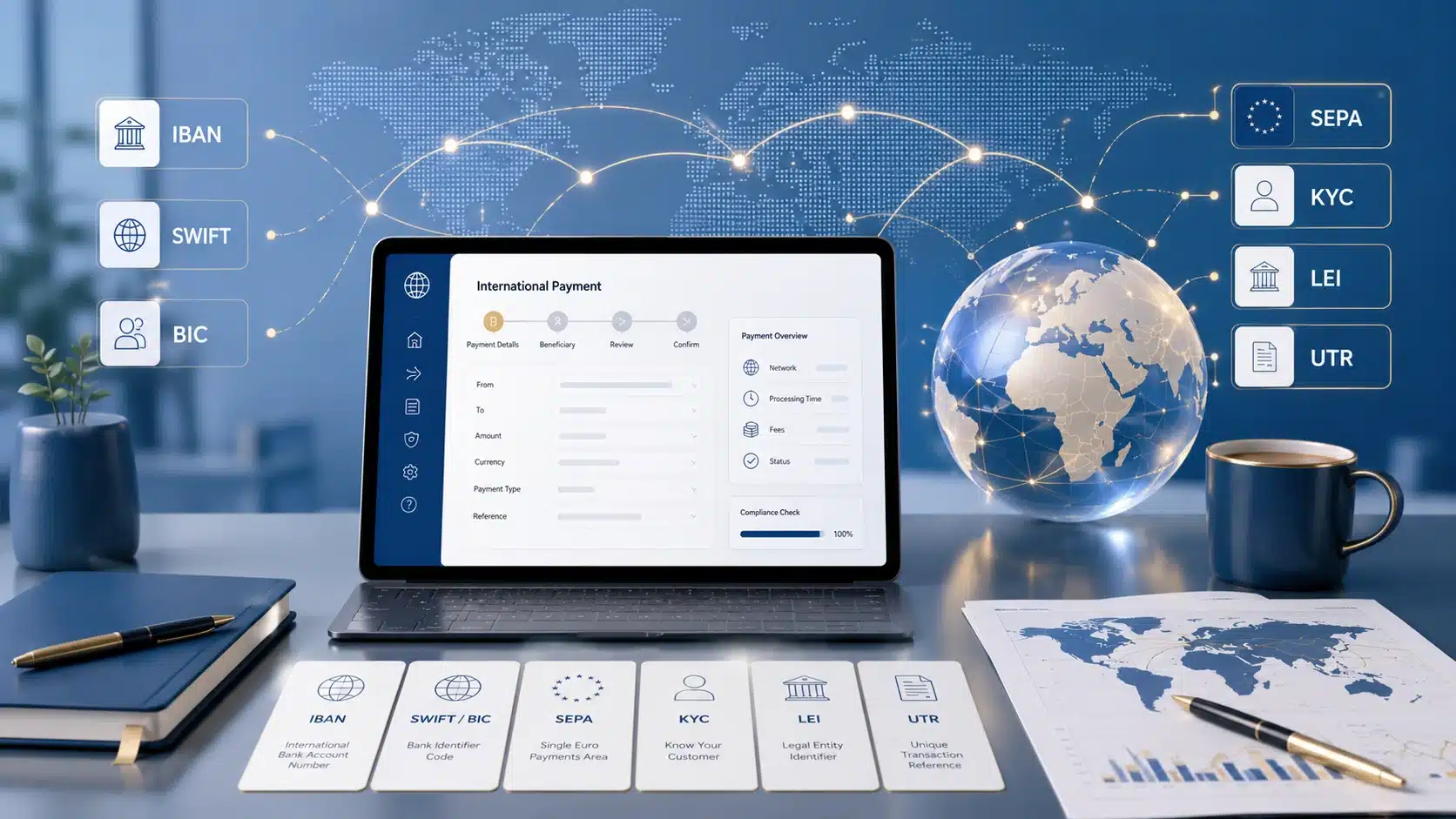
International banking reference

Essential Banking Codes and Payment Terms Explained

A practical quick-reference guide to common bank codes, account identifiers, compliance terms and international payment terminology.

International banking codes and global payment terminology

Account and institution identifiers

Codes used to identify accounts and financial institutions

These identifiers help banks and payment providers direct payments to the correct account and institution.

IBAN

International Bank Account Number

A standardised account identifier used to help process domestic and cross-border payments. Its exact length and structure depend on the country that issued the account.

An IBAN identifies the account. It does not by itself identify every operational detail of the receiving bank.

BIC

Business Identifier Code

An international identifier used for financial institutions and other business parties. A BIC normally contains eight characters, with an optional three-character branch identifier.

BIC is often informally called a SWIFT code, although BIC is the formal identifier and Swift is the messaging network and standards organisation.

SWIFT

Global Financial Messaging Network

Swift provides secure financial messaging used by banks and financial institutions to exchange payment instructions and other financial information.

Swift normally carries the payment message. It does not itself hold the sender’s or recipient’s money.

LEI

Legal Entity Identifier

A globally recognised identifier that connects a legal entity to authoritative reference information such as its official name and registered address.

LEIs are commonly relevant in regulated financial markets and transactions where clear legal-entity identification is required.

UTR

Unique Transaction Reference

A reference assigned to a payment or transaction so it can be identified in records, statements or support enquiries.

The term and format vary between countries and providers. In UK taxation, UTR can instead mean Unique Taxpayer Reference.

UETR

Unique End-to-End Transaction Reference

A unique reference attached to qualifying Swift payment messages so participating institutions can trace the payment through the processing chain.

UETR is specifically associated with payment tracking and should not be confused with every provider’s general transaction ID.

Payment schemes

Common European payment terms

These terms describe payment schemes and processes rather than individual bank accounts.

SEPA

Single Euro Payments Area

A framework that uses harmonised rules for euro payments across participating European countries.

SEPA concerns payments in euros. A business does not necessarily need to be located in the euro area to hold an eligible euro account.

SCT

SEPA Credit Transfer

A standard euro credit transfer made under the SEPA Credit Transfer scheme between participating payment service providers.

Processing time, cut-off times and availability depend on the provider and the circumstances of the payment.

SCT Inst

SEPA Instant Credit Transfer

An instant euro payment scheme designed to make eligible funds available to the recipient within seconds, at any time of day.

Both the sending and receiving payment service providers must support the relevant instant-payment service.

SDD

SEPA Direct Debit

A euro payment method in which the creditor collects money from the payer’s account under an agreed mandate.

Consumer and business-to-business direct debit arrangements may follow different rules.

FPS

Faster Payments Service

A UK payment system used for eligible pound sterling transfers between participating institutions.

Transaction limits, availability and timing are determined by the participating provider.

CHAPS

Clearing House Automated Payment System

A UK same-day payment system commonly used for time-sensitive or higher-value pound sterling payments.

Fees and submission deadlines vary between banks and payment providers.

Compliance and verification

Terms used during financial onboarding

KYC

Know Your Customer

The process used to identify and verify a customer and understand the nature of the intended business relationship.

For companies, checks can include directors, shareholders, beneficial owners, business activity and expected transactions.

CDD

Customer Due Diligence

The wider process of collecting and assessing customer information, ownership, purpose, expected activity and risk.

Due diligence may continue after account opening through ongoing reviews and transaction monitoring.

EDD

Enhanced Due Diligence

Additional checks applied when a relationship, ownership structure, country, activity or transaction profile presents increased risk.

EDD can involve more detailed evidence about funds, ownership, counterparties and commercial activity.

UBO

Ultimate Beneficial Owner

The individual who ultimately owns or controls a company or benefits from its activities, even when ownership is held through another company or structure.

PEP

Politically Exposed Person

A person entrusted with a prominent public function, or in some circumstances a connected family member or close associate.

PEP status does not automatically imply wrongdoing but normally requires closer risk assessment and monitoring.

POA

Proof of Address

A document used to verify a person’s residential address or, in some contexts, a company’s operational or correspondence address.

Accepted documents and permitted document age vary by provider.

International payment terminology

Words commonly shown on transfer forms

Beneficiary
The person or company intended to receive the payment.
Beneficiary bank
The bank or payment institution that holds the recipient’s account.
Ordering customer
The person or company instructing the payment. This may also be described as the payer or originator.
Correspondent bank
An intermediary institution used when the sending and receiving banks do not settle the payment directly with each other.
Intermediary bank
A bank involved between the sending institution and the final beneficiary bank during payment processing.
Payment reference
Information included with a payment to help the recipient identify its purpose, invoice, customer or order.
Value date
The date used by the provider when calculating when funds become effective for settlement, interest or account purposes.
Cut-off time
The provider’s deadline for receiving a payment instruction for processing within a particular business day.
Settlement
The stage at which payment obligations between the relevant financial institutions are completed.
Remittance information
Payment-related information sent to help the beneficiary reconcile the transfer with an invoice, contract or other obligation.
Nostro account
An account a bank holds with another bank, commonly in a foreign currency, to facilitate settlement and international payments.
Vostro account
The same correspondent account viewed from the institution that holds the account for the other bank.
Currency overview

The Euro (€)

The euro is a major international currency and the official currency of the euro area. It is widely used for trade, invoices, savings and cross-border business payments.

A euro account can help a business receive and send euro payments without converting every transaction into another operating currency.

European payments

SEPA Payments

SEPA provides harmonised rules for euro credit transfers and direct debits across participating countries, making eligible euro payments more consistent.

Standard and instant payments are separate services. Availability, fees, limits and processing depend on the account provider and the receiving institution.

Important distinctions

Codes that are often confused

Several banking terms appear together on payment forms, but they perform different functions.

IBAN Identifies the receiving account according to the relevant national IBAN format.
BIC Identifies the institution or business party involved in the transaction.
SWIFT Provides the messaging environment used to exchange financial instructions.
SEPA Describes harmonised schemes for euro payments in participating European countries.
UTR Usually refers to a transaction reference, but its precise use varies by country and provider.
UETR A unique end-to-end tracking reference used with qualifying Swift payment messages.

Before sending a payment

Three simple checks

1

Check the recipient details

Confirm the beneficiary name, account number or IBAN and any required institution code before authorising the payment.

2

Use a clear reference

Include an invoice number, customer reference or other information that allows the beneficiary to identify the payment.

3

Confirm the payment route

Check the currency, payment scheme, estimated processing time, potential intermediary fees and recipient-country requirements.

Important information

Banking terminology, document requirements, payment availability, limits, fees and processing times vary between countries and providers. Always follow the instructions shown by the relevant bank or payment institution and verify recipient details before sending money.

A Quick Reference for International Payments

Use this guide to identify the most common codes and terms shown during business account onboarding and cross-border payment processing.