

International Business Guide

Hong Kong Company Formation for Non-Residents

A practical guide for international entrepreneurs considering a Hong Kong private limited company, including directors, shareholders, company secretary, registered office, incorporation documents, business-account preparation, taxation and ongoing compliance.

Hong Kong company formation for non-residents and international entrepreneurs

Hong Kong company formation for non-residents and international entrepreneurs, from incorporation and company documents to banking and ongoing compliance.

Can a Non-Resident Form and Own a Hong Kong Company?

Yes. Non-Hong Kong residents can incorporate a local limited company in Hong Kong. A director of a private Hong Kong company does not generally need to live in Hong Kong.

The company itself must meet Hong Kong requirements, including maintaining a registered office in Hong Kong and appointing an eligible company secretary.

Company formation should be considered separately from banking, immigration and personal tax residence. Registering a Hong Kong company does not automatically give the owner residence rights or guarantee approval for a business account.

Contact BR Economy About Hong Kong
1
Non-Residents Can Incorporate International founders do not need to become Hong Kong residents simply to establish a local limited company.
2
Non-Resident Directors Are Possible A private company needs at least one natural-person director, but the director does not have to reside in Hong Kong.
3
Local Administration Is Required The company needs a Hong Kong registered office and a company secretary meeting the applicable local requirements.
4
Banking Is Separate Banks and financial platforms perform their own onboarding, KYC and business-verification procedures.

What a Hong Kong Private Limited Company Needs

A standard private company limited by shares will normally need the following ownership, management and local administrative arrangements.

Directors and Shareholders

Ownership and Management

A private company must have at least one director who is a natural person. The company can also have one or more shareholders.

  • At least one natural-person director
  • Director does not need to reside in Hong Kong
  • One or more shareholders
  • International ownership is possible
  • Share ownership must be properly recorded
Company Secretary

Local Administration

A Hong Kong private company must appoint a company secretary who meets the local requirements.

  • Individual secretary must ordinarily reside in Hong Kong
  • Corporate secretary must have a Hong Kong office
  • Sole director cannot also be the company secretary
  • Secretary supports statutory company administration

Hong Kong Registered Office

Official Company Address

The registered office of a local Hong Kong limited company must be located in Hong Kong.

  • Registered office situated in Hong Kong
  • Address included in incorporation information
  • Official company correspondence can be received there
  • Directors may continue to reside outside Hong Kong

From Company Name to Incorporation

A Hong Kong private company limited by shares commonly moves through the following stages.

1

Choose the Company Name

Select the proposed company name and check it against the Hong Kong Companies Registry naming requirements before the incorporation application is submitted.

2

Prepare Director and Shareholder Information

Identify the proposed directors, shareholders and ownership structure.

International founders should prepare clear identification and residential-address documentation because professional service providers and financial institutions may need these documents during their own verification procedures.

3

Arrange the Hong Kong Registered Office

The company must have a registered office situated in Hong Kong. This should be arranged before the incorporation information is finalised.

4

Appoint the Company Secretary

Appoint an eligible company secretary. International founders commonly use a professional Hong Kong corporate-services provider for this ongoing administrative function.

5

Prepare the Incorporation Documents

A standard Hong Kong company limited by shares requires the incorporation form, Articles of Association and related business-registration information.

  • Company name
  • Hong Kong registered office
  • First director or directors
  • Company secretary
  • Founder member and shareholder information
  • Share capital and ownership information
  • Articles of Association
6

Submit Form NNC1 and IRBR1

A Hong Kong company limited by shares is incorporated using Form NNC1 together with IRBR1 and the supporting incorporation documents.

Applications can be submitted through the Companies Registry e-Services system or another permitted filing method.

7

Receive the Company Registration Documents

Once incorporation has been approved, the company receives its Certificate of Incorporation and Business Registration Certificate.

8

Prepare Banking, Accounting and Compliance

After incorporation, organise the company’s statutory records, accounting arrangements and business-account application. Banking should ideally already have been considered so the intended provider’s requirements are understood.

What Documents Should Be Prepared and Retained?

Good company documentation is important for statutory administration and can also simplify future bank, fintech and payment-provider verification.

Information Commonly Needed Before Registration

  • Proposed company name
  • Director details
  • Shareholder details
  • Passport or accepted identification where required
  • Residential address information
  • Hong Kong registered office address
  • Company secretary details
  • Share capital and ownership structure
  • Business activity information
  • Articles of Association
  • Form NNC1 information
  • IRBR1 business-registration information
KYC for International Founders

A professional company-formation or corporate-services provider may request additional identification, proof of residential address and information about the intended business as part of its own customer-verification procedures.

Documents and Records After Incorporation

  • Certificate of Incorporation
  • Business Registration Certificate
  • Articles of Association
  • Filed incorporation information
  • Shareholder and share-capital records
  • Share certificates where applicable
  • Register of members
  • Director records
  • Company-secretary records
  • Significant Controllers Register where applicable
  • Corporate resolutions and statutory records
Significant Controllers Register

Most local Hong Kong companies are required to identify significant controllers and maintain the applicable register in Hong Kong.

Plan the Business Account Before You Form the Company

For a non-resident founder, opening and maintaining a suitable business account can be one of the most important practical considerations when establishing a Hong Kong company.

Company incorporation and account approval are separate processes. A registered Hong Kong company can consider traditional banks as well as suitable digital or fintech business-account providers, but each provider applies its own eligibility, KYC and risk-assessment procedures.

Traditional Hong Kong Bank

A suitable company may apply to a conventional Hong Kong bank. The bank may review the owners, directors, business activity, expected transactions and commercial purpose of the account.

Digital or Fintech Business Account

Digital and fintech providers can provide another account route for some international companies. Their country, ownership and activity requirements differ and should be checked before applying.

Documents Commonly Requested During Account Onboarding

  • Certificate of Incorporation
  • Business Registration Certificate
  • Articles of Association
  • Company ownership and shareholding information
  • Director and beneficial-owner identification
  • Residential address evidence where requested
  • Hong Kong registered office information
  • Description of the company’s products or services
  • Company website or online presence where available
  • Expected customers and suppliers
  • Countries connected to the business
  • Expected monthly transaction volumes
  • Expected currencies
  • Source of initial company funds
  • Contracts, invoices or other evidence of business activity where requested
Registration Does Not Guarantee an Account

A Certificate of Incorporation establishes the company but does not create an automatic entitlement to a bank, EMI or fintech account. The financial provider always makes its own onboarding decision.

Explain the Business Clearly

Account applications are easier to assess when the provider can understand what the company sells, who its customers and suppliers are, which countries are involved and how the proposed account will actually be used.

How Are Company Profits Taxed in Hong Kong?

Hong Kong operates a territorial system of taxation. The key question is generally where the company’s profits arise or are derived, rather than simply where the company is incorporated or where its shareholders live.

Hong Kong profits tax rates and territorial taxation for companies

Hong Kong Generally Taxes Hong Kong-Sourced Profits

Hong Kong follows the territorial source principle of taxation. A company carrying on a trade, profession or business in Hong Kong is generally subject to profits tax on profits arising in or derived from Hong Kong.

Profits genuinely arising outside Hong Kong can therefore fall outside the Hong Kong profits-tax charge, subject to the applicable rules. The result depends on the actual operations and transactions that generate the profit.

Non-Resident Ownership Does Not Determine the Tax Result

The residence or nationality of the shareholder is not by itself what determines whether company profits are taxable in Hong Kong. The source and nature of the profits must be considered.

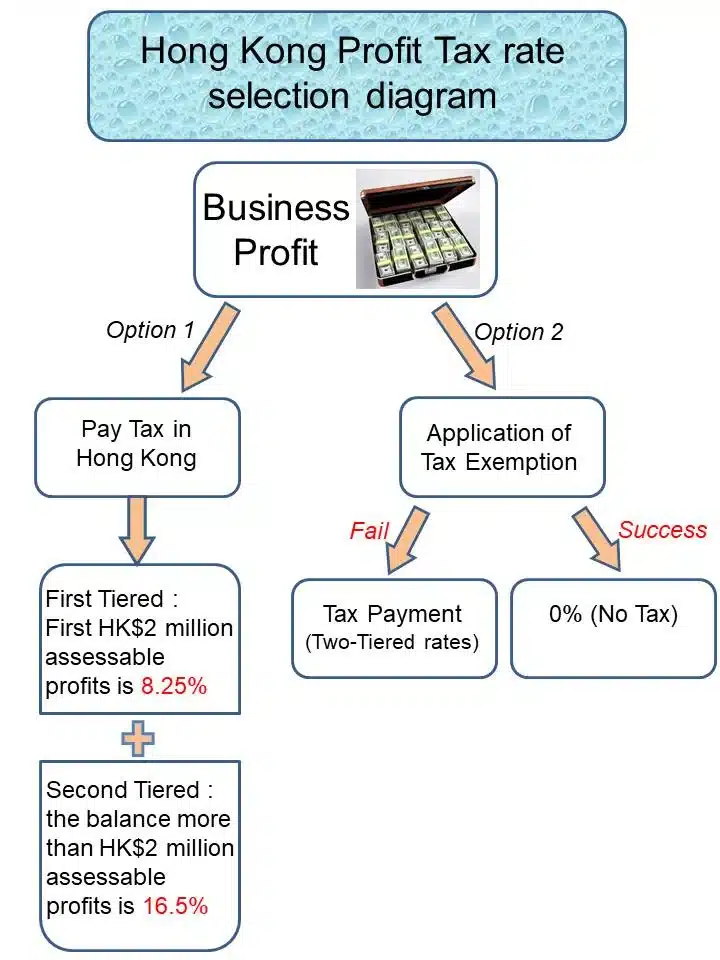
First HK$2 Million of Assessable Profits

8.25%

Under the two-tiered profits tax regime, qualifying corporations can be taxed at 8.25% on the first HK$2 million of assessable profits.

Assessable Profits Above HK$2 Million

16.5%

The portion of assessable profits above HK$2 million is generally subject to the standard corporation profits-tax rate of 16.5%. Special rules can affect connected entities.

What About Profits Generated Outside Hong Kong?

The territorial principle means that foreign-sourced profits are not automatically brought into the Hong Kong profits-tax charge merely because the company is incorporated in Hong Kong.

Whether profits are genuinely foreign-sourced is a factual question. The relevant profit-producing operations and where those activities take place need to be considered.

Foreign-Sourced Income Rules

Hong Kong’s Foreign-sourced Income Exemption regime introduces additional rules for certain multinational group entities receiving specified foreign-sourced income in Hong Kong, including certain interest, dividends and disposal gains. Applicable exemption and economic-substance conditions may therefore need to be considered.

Offshore Status Should Never Be Assumed

Overseas customers, foreign payment processing or a non-resident director do not automatically make the company’s profits offshore. The source of profits should be assessed from the company’s real activities and transactions.

No General VAT or GST

Hong Kong does not operate a general Value Added Tax or Goods and Services Tax system. This distinguishes it from many jurisdictions where businesses collect a broad consumption tax on sales.

1
No General VAT Hong Kong does not impose a general Value Added Tax.
2
No GST Hong Kong does not operate a general Goods and Services Tax.
3
No General Capital Gains Tax Hong Kong does not impose a separate general capital gains tax, although gains arising from trading or profit-making activities can be treated differently.
4
No General Dividend Tax Hong Kong does not impose a general tax on dividends paid by Hong Kong companies.
Interest Income Requires More Care

It is too broad to say that all interest income is tax-free. The treatment can depend on the nature and source of the income, the company’s activities and, for relevant multinational group entities, the foreign-sourced income rules.

Free Flow of Capital

Hong Kong maintains free movement of capital and does not apply general foreign-exchange control policies. The Hong Kong dollar remains freely convertible.

Capital Movement and Tax Are Different Questions

The ability to move capital into or out of Hong Kong does not determine whether a particular company’s profits or income are taxable. Tax treatment must still be assessed separately.

Need to Understand Your Hong Kong Tax Position?

International structures can involve both Hong Kong tax rules and the tax rules of the country where the owner lives or manages the business. The source of profits should therefore be considered according to the company’s actual activities.

BR Economy can help identify the practical questions that should be reviewed and coordinate the next step with appropriate specialists where professional tax advice is required.

Contact BR Economy

Maintain the Hong Kong Company After Registration

A Hong Kong private limited company remains subject to ongoing corporate, accounting and tax obligations after incorporation. Non-resident ownership does not remove these responsibilities.

  • Maintain the Hong Kong registered office
  • Maintain an eligible company secretary
  • Keep director and shareholder information current
  • Maintain company and ownership records
  • Maintain the Significant Controllers Register where applicable
  • Report relevant corporate changes
  • Maintain the Business Registration Certificate
  • File the annual return with the Companies Registry
  • Maintain proper accounting records
  • Prepare required financial statements
  • Meet applicable tax and audit obligations
Annual Return – Form NAR1

A local private company generally files its annual return using Form NAR1 within 42 days after the anniversary of its date of incorporation. Relevant company changes may also need to be reported separately when they occur.

Need Help with a Hong Kong Company?

BR Economy works with an established Hong Kong corporate-services partner and can assist international founders with understanding the formation process and preparing the next steps.

Depending on the proposed structure, assistance can include company-formation coordination, registered-office and company-secretary arrangements, preparation of company documentation and preparation for suitable traditional or digital business-account applications.

Bank and fintech approval always remains with the relevant financial provider. We therefore prefer to understand the company’s intended activities, ownership and countries involved before suggesting an appropriate account route.

Contact BR Economy

Frequently Asked Questions

Hong Kong Company Formation for Non-Residents

Common questions from international entrepreneurs considering a Hong Kong private limited company.

Can a non-resident form a company in Hong Kong?

Yes. Non-Hong Kong residents can incorporate a local limited company in Hong Kong.

The founder does not need to become a Hong Kong resident simply to own the company, but the company itself must meet the applicable Hong Kong registration and administration requirements.

Does a Hong Kong company director need to live in Hong Kong?

No. A private Hong Kong company must have at least one director who is a natural person, but the director does not generally need to be resident in Hong Kong.

Does the company need a registered office in Hong Kong?

Yes. A local Hong Kong limited company must maintain a registered office in Hong Kong.

This is the company’s official address for statutory purposes and should not be confused automatically with the founder’s residential address or a separate trading location.

Is a company secretary required?

Yes. A Hong Kong private company must appoint a company secretary.

An individual company secretary must ordinarily reside in Hong Kong, while a corporate secretary must have its registered office or place of business in Hong Kong.

Where a company has only one director, that person cannot also act as the company’s secretary.

What documents are normally issued after incorporation?

Once incorporation is completed, the company normally receives a Certificate of Incorporation and a Business Registration Certificate.

The company should also retain its Articles of Association, shareholder and director information, share-capital records, corporate resolutions and other statutory records.

Does forming a Hong Kong company guarantee a bank account?

No. Company incorporation and business-account approval are completely separate processes.

Banks, fintech companies and other financial providers apply their own eligibility, KYC and risk-assessment procedures. They may review the owners, directors, business activity, countries involved, expected transactions and source of funds.

Can a Hong Kong company use a digital or fintech business account?

Potentially, yes. Depending on the company’s ownership, activities and countries involved, a digital or fintech provider may provide an alternative to a traditional Hong Kong bank.

Eligibility differs between providers, so the intended account route should ideally be considered before the company is formed.

What information can a bank request from a non-resident founder?

Requirements vary, but common requests include identification for directors and beneficial owners, proof of residential address, company incorporation documents and ownership information.

Providers may also ask for a clear business description, website, expected customers and suppliers, countries involved, currencies, expected transaction volumes, source of funds, contracts or invoices.

How are company profits taxed in Hong Kong?

Hong Kong operates a territorial profits-tax system. The key question is generally whether the relevant profits arise in or are derived from Hong Kong.

The tax result does not depend simply on where the shareholder lives or on the fact that the company has overseas customers. The real profit-producing activities and transactions need to be considered.

Are all foreign profits automatically tax-free in Hong Kong?

No. It is too broad to assume that every profit connected with another country is automatically exempt from Hong Kong tax.

Foreign-sourced profits can fall outside the Hong Kong profits-tax charge in appropriate circumstances, but the source of the profits is a factual question.

Additional Foreign-sourced Income Exemption rules can also apply to certain multinational group entities receiving specified foreign-sourced income in Hong Kong.

What are the Hong Kong corporation profits-tax rates?

Under the two-tiered profits tax regime, qualifying corporations can generally be taxed at 8.25% on the first HK$2 million of assessable profits.

The portion above HK$2 million is generally taxed at 16.5%. Special rules can affect the application of the two-tiered regime, including rules involving connected entities.

Does Hong Kong have VAT or GST?

No. Hong Kong does not impose a general Value Added Tax or Goods and Services Tax.

This means that Hong Kong does not operate the broad VAT/GST system commonly used in many European and other jurisdictions.

Does Hong Kong have a general capital gains tax?

Hong Kong does not impose a separate general capital gains tax.

However, the description of a receipt as a capital gain does not automatically determine the tax result. Gains arising from trading or profit-making activities can be treated as taxable profits depending on the circumstances.

Are dividends taxed in Hong Kong?

Hong Kong does not impose a general tax on dividends paid by Hong Kong companies.

International owners should still consider whether dividends create tax obligations in their own country of residence.

Does Hong Kong restrict the movement of capital?

Hong Kong generally maintains free movement of capital and does not operate general foreign-exchange controls.

This should not be confused with banking compliance. Banks and payment providers can still apply their own controls, KYC procedures and transaction-monitoring requirements.

Does owning a Hong Kong company give me residence in Hong Kong?

No. Company ownership and immigration status are separate matters.

Incorporating or owning a Hong Kong company does not by itself grant the shareholder or director an automatic right to live or work in Hong Kong.

What ongoing obligations does a Hong Kong company have?

A Hong Kong private company must continue to maintain its registered office, eligible company secretary, statutory records and relevant ownership information.

The company must also meet applicable annual-return, accounting, financial-statement, audit and tax-filing requirements.

When is the Hong Kong annual return filed?

A local private company generally files its annual return using Form NAR1 within 42 days after the anniversary of its incorporation date.

Certain changes to company particulars may need to be reported separately when they occur and should not simply be left until the annual return.

Can BR Economy assist with Hong Kong company formation?

Yes. BR Economy works with an established Hong Kong corporate-services partner and can assist international founders with understanding and coordinating the practical formation process.

Depending on the structure, assistance can include preparation for company incorporation, registered-office and company-secretary arrangements, company documentation and preparation for suitable business-account applications.

Bank or fintech approval remains entirely with the relevant financial provider.

Considering a Hong Kong Company as a Non-Resident?

Contact BR Economy for practical guidance on company formation, registered-office and company-secretary arrangements, documentation and preparation for a suitable business-account application.

Contact BR Economy

BR Economy provides general business information and practical formation guidance. We do not provide legal, tax, immigration or financial advice. Company, banking and tax requirements depend on the business structure, activities, ownership and individual circumstances.